

LONGi Achieves 35.5 Percent Efficiency in Tandem Solar Cell Development
Chinese manufacturer LONGi has reached a new milestone in photovoltaic technology, reporting a 35.5 percent conversion efficiency for its crystalline silicon-perovskite tandem solar cells. This development marks a significant step toward bridging the gap between high-performance laboratory prototypes and commercially viable renewable energy solutions.
The solar energy industry has reached a new technical milestone as Chinese manufacturer LONGi announced that its latest crystalline silicon-perovskite tandem solar cell has achieved a conversion efficiency of 35.5 percent. This figure, which has been verified by the European Solar Test Installation, represents a notable advancement over current market standards. For context, the US Energy Information Administration notes that most commercially available solar panels currently operate at approximately 25 percent efficiency.
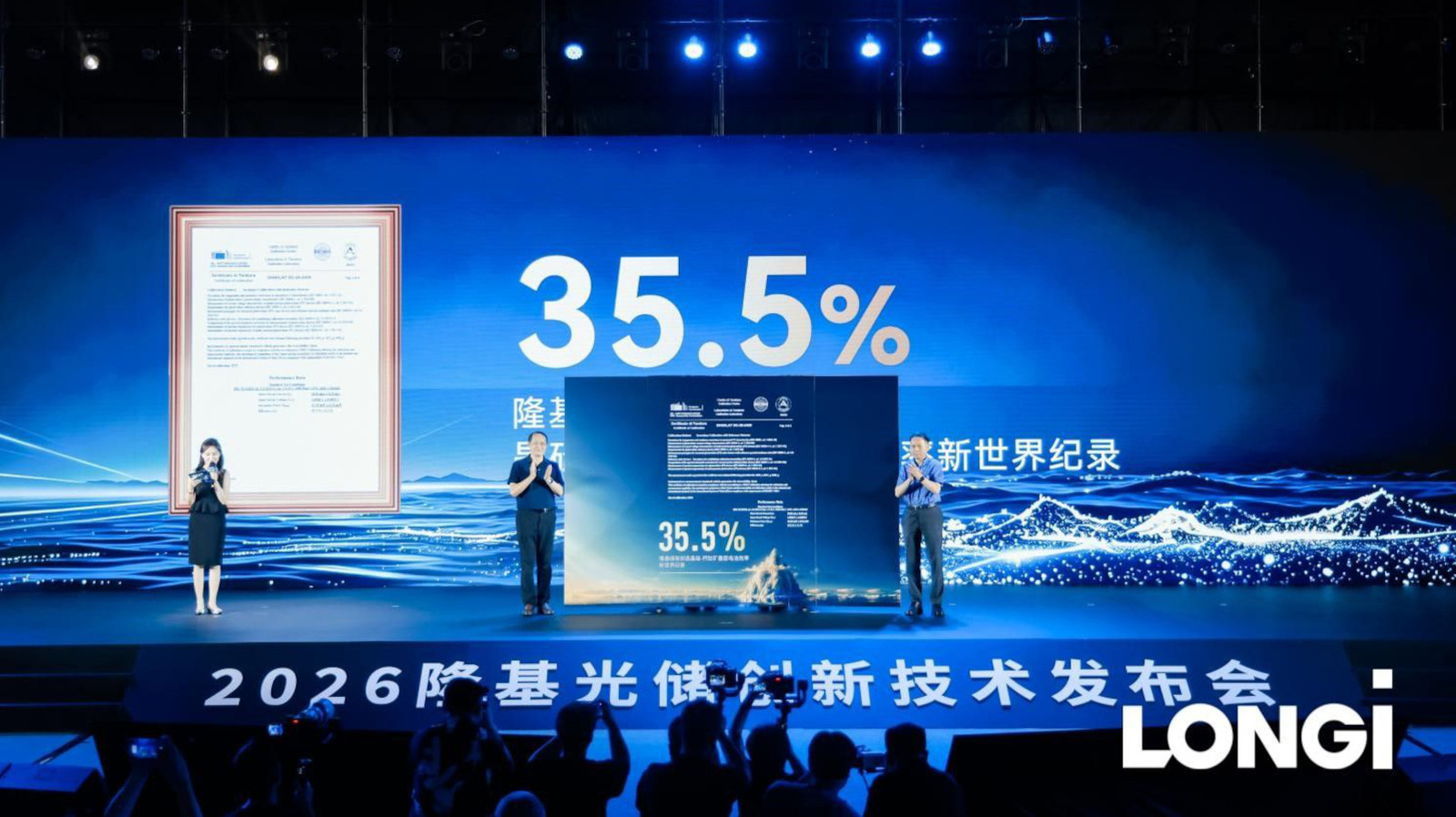
The mechanics behind this achievement rely on tandem cell architecture, which layers different materials to capture a broader spectrum of sunlight. By combining crystalline silicon with perovskite, researchers can theoretically push conversion limits significantly higher than traditional single-junction silicon cells. LONGi has demonstrated a consistent trajectory of improvement, moving from 33.9 percent efficiency in November 2023 to 34.6 percent in June 2024, before reaching the current 35.5 percent benchmark. The company maintains that this specific technology holds a theoretical ceiling of 43 percent efficiency.
While this achievement sets a record for this specific class of photovoltaic technology, the broader landscape of solar research remains highly competitive. The US Department of Energy's National Renewable Energy Laboratory previously reported a solar cell efficiency of 39.5 percent in 2022, though such high-performance cells are often relegated to specialized applications like satellite power systems rather than mass-market utility.
The primary challenge for the industry remains the transition from laboratory records to large-scale manufacturing. While record-breaking percentages provide a roadmap for future innovation, the ultimate impact of these advancements will be determined by the ability of manufacturers to commercialize these high-efficiency cells at a cost that makes them accessible for global energy infrastructure. As the industry continues to iterate, the focus is shifting from simply breaking records to solving the logistical and economic hurdles required to integrate these high-efficiency cells into the global power grid.